![WellDatabase-Rect-1000x159-1.png]](https://support.welldatabase.com/hs-fs/hubfs/WellDatabase-Rect-1000x159-1.png?height=40&name=WellDatabase-Rect-1000x159-1.png)
Common Reasons for Negative Production
Negative production volumes are uncommon but are a valid part of public production data reported by some state regulatory agencies. They almost always represent accounting or inventory corrections, not negative physical production.
- Tank inventory reconciliations – Production may have been stored in tanks during one month and sold in another. If tank measurements reveal an earlier overstatement, a negative adjustment may be reported to correct the balance.
- Amended production reports – Operators may revise previously submitted production after discovering reporting errors or receiving updated measurements.
- Sales vs. production timing – Oil or gas sales do not always occur in the same month as production. Corrections may be necessary when reconciling production, sales, and inventory.
- Operator or ownership changes – Transfers between operators or reporting entities can require adjustments to previously reported volumes.
- Regulatory corrections – A state regulatory agency may accept amended filings that reverse or reallocate production reported in prior months.
- Data entry or measurement corrections – Meter calibration, tank gauge corrections, unit conversion errors, or duplicate reporting may result in negative values when previously reported production is adjusted.
Examples from State Regulatory Agencies
WellDatabase has observed negative production values in production data published by several state regulatory agencies, including Colorado, Michigan, Montana, New Mexico, and West Virginia. The examples below illustrate two common scenarios.
Example: Colorado (ECMC)
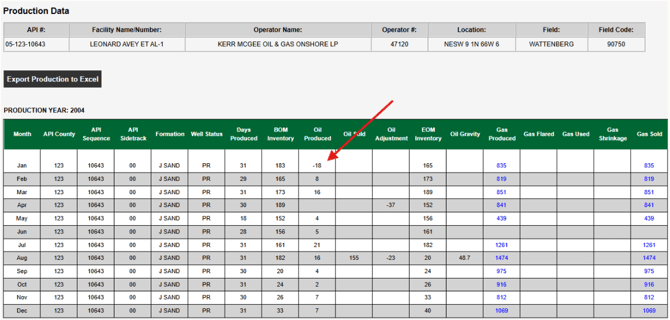
The example below shows a Colorado (ECMC) production record where the state reported -18 barrels of oil produced for January 2004. While this may appear unusual, values like this are typically the result of inventory reconciliations, amended reports, or other accounting corrections rather than negative physical production.
Example: West Virginia (WVDEP)
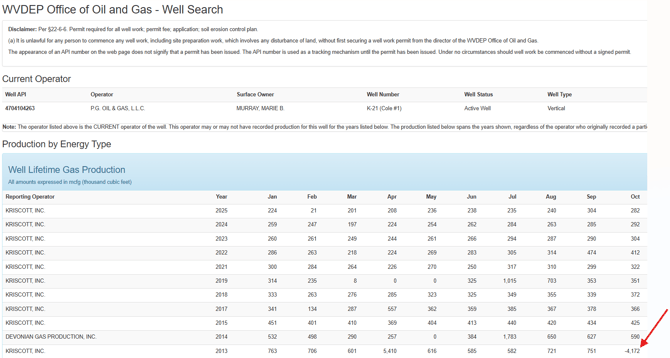
The example below shows a West Virginia (WVDEP) production record where the state reported -4,172 Mcf of natural gas for October 2013. Although much larger, this value represents the same type of accounting correction rather than negative physical gas production.
What Negative Production Does Not Mean
Negative values generally do not indicate that a well physically produced negative oil, gas, or water. Instead, they reflect corrections to historical accounting records intended to ensure cumulative reported production and inventories remain accurate.
How WellDatabase Handles Negative Production
WellDatabase preserves these state-reported records in its raw data and applies standardized quality controls where appropriate for analytical products.
Frequently Asked Questions
Q: Does a negative production value mean the well produced negative oil or gas?
A: No. Negative values almost always represent accounting, reporting, or inventory corrections made by the regulatory agency or operator.
Q: Does WellDatabase create these negative values?
A: No. These values originate from publicly available regulatory data. WellDatabase preserves the reported records and applies standardized quality controls where appropriate for analytical products.
Q: Why doesn't WellDatabase change negative production values to zero?
A: WellDatabase preserves production values as they are reported by the state regulatory agency. Negative production values are part of the official production record and typically represent accounting or reporting corrections. Replacing those values with zero would alter the published state data and could affect cumulative production totals and historical reporting accuracy.
Q: Should negative production values be considered errors?
A: Not necessarily. While they may result from correcting previous reporting errors, the negative values themselves are often valid regulatory adjustments intended to reconcile historical production records.
Explore additional articles by searching the topics on the left. If you have any questions, feel free to email support@welldatabase.com.