![WellDatabase-Rect-1000x159-1.png]](https://support.welldatabase.com/hs-fs/hubfs/WellDatabase-Rect-1000x159-1.png?height=40&name=WellDatabase-Rect-1000x159-1.png)
Infinity ID is the unique internal identifier assigned to each well record in WellDatabase.
Infinity IDs are generated automatically and remain consistent throughout the lifecycle of the record. This provides a reliable way to reference wells across datasets, exports, APIs, and integrations.
We recommend using Infinity ID when mapping or integrating WellDatabase data into external systems.
What is a Universally Unique Identifier (UUID) or a Globally Unique Identifier (GUID)?
Infinity ID (WellID, ID)
The Infinity ID is the unique identifier assigned to a well record in WellDatabase.
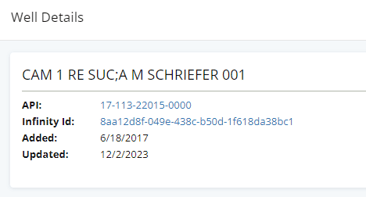
Well Details
The Infinity ID is displayed within the Well Details card.
Exports
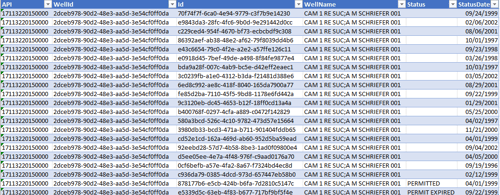
In exported datasets, the Infinity ID is referenced as WellID.

ID Values in Other Record Types
In addition to the Infinity ID assigned to the well itself, individual records within datasets may also have their own unique ID values.
For example:
• In well-level datasets, the Id and WellID may reference the same well record.
• In datasets such as Completions, Permits, or other related record types, each row may contain its own unique Id while still referencing the parent well through the WellID field.
This structure helps uniquely identify individual records while maintaining a connection back to the associated well.
Benefits of Infinity ID
API numbers in the U.S. and UWI values in Canada are commonly used for locating wells and are often easier to recognize during daily workflows.
However, when integrating or mapping WellDatabase data into external systems, using the WellID provides a more reliable unique identifier.
Benefits of using Infinity ID (WellID, ID) include:
• More consistent record matching across datasets
• Reduced risk of duplicate or ambiguous records
• Reliable well identification across APIs, exports, and integrations
• Better tracking of related record types tied to the same well
Duplicate API Numbers
While API numbers are typically unique identifiers, there are cases where multiple well records may share the same API number.
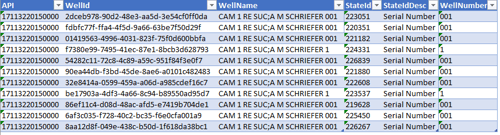
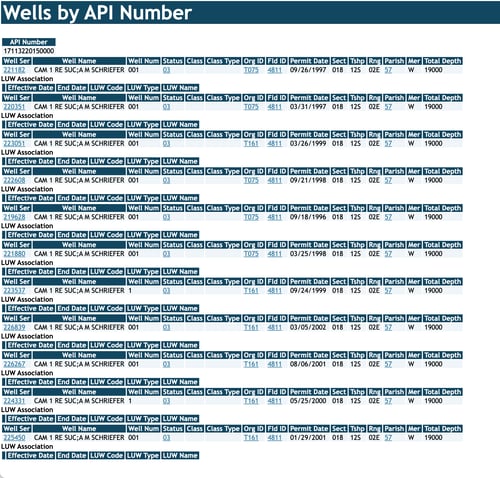
In this example, 11 well records share the same API number within the state records. While the API number is the same, each record still contains slight variations in well information along with its own unique State ID and WellID (Infinity ID).
Exported Data from WellDatabase
Louisiana State Site
Frequently Asked Questions
Q: What is Infinity ID?
A: Infinity ID is the unique internal identifier assigned to each well record in WellDatabase.
Q: Is WellID the same as Infinity ID?
A: Yes. In exported datasets and integrations, the Infinity ID is commonly referenced as WellID.
Q: What is the difference between API and Infinity ID?
A: API numbers are industry-standard well identifiers. Infinity ID provides a unique identifier for well records across WellDatabase datasets, exports, APIs, and integrations.
Q: Why would I use Infinity ID instead of API?
A: Infinity ID provides a more reliable unique identifier when working with integrations and large datasets where duplicate or ambiguous API records may exist.
Q: Can I search by Infinity ID in WellDatabase?
A: Yes. Infinity IDs can be searched in the Well Finder by selecting the Id search type.
Q: Does every well have an Infinity ID?
A: Yes. Every well record in WellDatabase is assigned a unique Infinity ID.
Q: Can multiple wells share the same API number?
A: In some cases, yes. State reporting systems may contain multiple records associated with the same API number. Infinity ID ensures each record still has a unique identifier within WellDatabase.
Explore additional articles by searching the topics on the left. If you have any questions, feel free to email support@welldatabase.com