![WellDatabase-Rect-1000x159-1.png]](https://support.welldatabase.com/hs-fs/hubfs/WellDatabase-Rect-1000x159-1.png?height=40&name=WellDatabase-Rect-1000x159-1.png)
Completion data does not become available immediately after a well is completed. The timing varies by state and depends primarily on operator filing requirements, regulatory review, confidentiality rules, and publication schedules before the information becomes publicly available.
In most cases, WellDatabase receives and processes completion data shortly after it becomes available from the applicable regulatory agency. The largest source of delay is typically the time required for operators to file completion information and for regulators to review and publish those records.
Completion data should be viewed as a progressively maturing dataset rather than a real-time measure of field activity.
Understanding the Completion Reporting Process
Several factors influence when completion data becomes available in WellDatabase.
-
Operator filing requirements: Operators are responsible for submitting completion information to the applicable state regulatory agency. Filing requirements and deadlines vary by state.
-
Regulatory review and publication: After a completion report is submitted, the regulatory agency reviews, processes, and publishes the information. Processing timelines vary significantly between states.
-
Confidentiality periods: Some states allow certain completion information to remain confidential for a period of time before it becomes publicly available. During this period, WellDatabase cannot display information that has not yet been released by the regulatory agency.
-
WellDatabase ingestion: Once completion information becomes publicly available through the applicable regulatory data sources, it is typically available in the WellDatabase platform the same day or within one business day.
Why Completion Counts Lag Reality
One of the most common misconceptions is that a missing completion record means a well has not yet been completed.
In reality, many recently completed wells are still moving through the regulatory reporting process.
Completion data is not delayed because WellDatabase receives data late. Most delays occur before the information becomes publicly available, including:
-
Operator filing
-
Regulatory review
-
Regulatory approval
-
Confidentiality periods, where applicable
-
Public publication of completion information
Only after those steps are complete can WellDatabase ingest the completion record.
As a result, completion counts for the most recent months should generally be considered preliminary. Historical completion counts often increase over time as additional records become publicly available.
Why Completion Timing Varies by State
Each state has its own regulatory reporting requirements, review process, publication schedule, and confidentiality rules.
Some states publish completion information relatively quickly after it is filed, while others may experience longer review cycles, publication delays, or confidentiality periods that significantly extend the time before completion data becomes publicly available.
As a result, the amount of time between a well's physical completion and when the completion record appears in WellDatabase can vary considerably from one state to another.
Completion Data Availability by State
The following summarizes typical completion data availability after a well has been completed. Actual timelines vary depending on the operator, the regulatory agency, and the specific circumstances of each well.
| State | Primary Filing |
Approximate Time to Public Availability | Additional Notes |
|---|---|---|---|
| Texas | Form W-2 – Completion Report | 3–5 months | Generally one of the faster states for completion visibility. |
| Colorado | Form 5 – Drilling Completion Report Form 5A – Completed Interval Report Form 7 – Production Report |
2–4 months | Multiple filing stages may affect timing. |
| Louisiana | Completion reports well tests work permits production filings |
2–5 months | Publication timing depends on regulatory processing and document indexing. |
| Oklahoma | Form 1002A – Completion Report | 3–6 months | Filing, processing, and publication timelines all contribute. |
| Wyoming | Completion reports | 2–6 months | Timing varies based on operator filing and regulatory review. |
| Ohio | Completion reports, stimulation disclosures, production reporting |
2–6 months | Processing timelines vary by completion reporting. |
| Pennsylvania | Completion reports, stimulation records, production reporting |
3–6 months | Publication timing depends on regulatory review and operator reporting. |
| West Virginia | Completion reports, stimulation reports, work permits, production reports |
4–9 months | Completion package processing and publication may extend timelines. |
| North Dakota | Completion reports, Well file documentation |
4–9+ months | Confidentiality periods may significantly delay public availability. |
| New Mexico | Form C-105 – Completion Report | 6–12+ months | Processing backlogs, publication timing, and confidentiality can substantially delay completion visibility. |
Completion Data Lag Analysis
Texas Completion Analysis
The following analysis summarizes observed completion data availability in Texas using WellDatabase completion records.
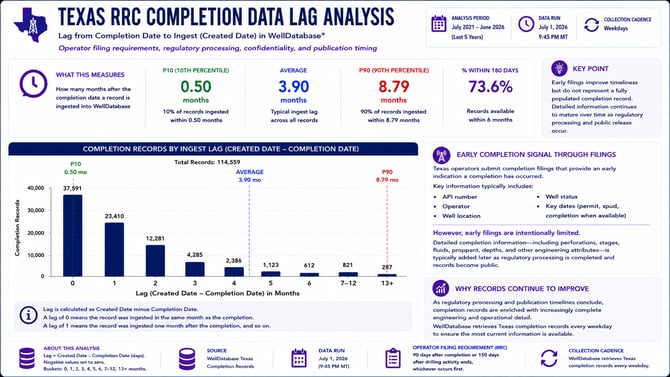
The analysis demonstrates that Texas completion data generally becomes publicly available more quickly than in many other states. Although many completion records become available within the first few months after completion, additional records continue to become available over time as operators submit filings and the RRC reviews and publishes the associated information.
New Mexico Completion Analysis
New Mexico follows a significantly different pattern than Texas. The following analysis summarizes observed completion data availability in New Mexico using WellDatabase completion records.
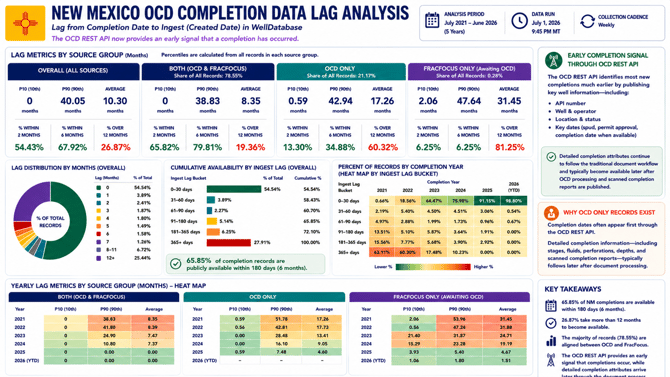
Completion records commonly take several additional months to become publicly available because of regulatory processing timelines, publication delays, and confidentiality periods. As a result, recently completed wells are more likely to be absent from public completion datasets for an extended period.
When analyzing recent completion activity, New Mexico completion counts should be interpreted with additional caution because recently completed wells may continue to appear for many months after the physical completion date. As additional completion records become publicly available, historical completion counts are expected to increase.
Key Takeaways
Completion data should be viewed as a progressively maturing dataset rather than a real-time measure of field activity.
The absence of a completion record does not necessarily mean a well has not been completed. In many cases, it means the operator has not yet filed the required information, the regulatory agency is still processing or publishing the record, or the information remains subject to a confidentiality period.
In most cases, the largest source of delay occurs before the data becomes publicly available. Once completion information is published by the applicable regulatory agency, WellDatabase typically makes it available in the platform the same day or within one business day.
Related Articles
- How is completion data sourced and standardized?
- What data is contained in Completion Records?
- How do I find completions by county for a state?
Frequently Asked Questions
Q: Why are recent completion counts lower than older months?
A: Recent completion counts are expected to be incomplete because many operators have not yet filed completion reports, regulators may still be processing filings, and some records have not yet been published. Completion counts for recent months should be considered preliminary and are expected to increase over time.
Q: Why does New Mexico show significantly longer delays than Texas?
A: Texas generally processes completion filings faster and publishes records more quickly. New Mexico has historically experienced larger processing backlogs, imaging delays, and confidentiality-related delays, resulting in completion records often appearing months later than comparable Texas wells.
Q: Does WellDatabase receive the data late?
A: No. WellDatabase ingests records shortly after they become publicly available. Most delays occur before publication, during operator filing, regulatory review, approval, and document publication processes.
Q: What does "Lag from Completion Date to Ingest (Created Date) in WellDatabase" mean?
A: This measurement represents the time between a well's reported completion date and the date the completion record first became available in WellDatabase. It reflects the total elapsed time before the record was available in the platform, including operator filing, regulatory review, publication, and WellDatabase's ingestion process.
Example:
• Completion Date: January 2025
• First Available in WellDatabase: April 2025
• Lag to Ingest: 3 months
Q: Why are some records available quickly while others take many months?
A: Operators file at different times, regulators process filings at different speeds, and some wells require additional review, amendments, or confidentiality treatment. As a result, availability varies significantly even within the same state.
Q: What does the P50 (Median) lag represent?
A: The P50 value represents the midpoint of the distribution. For New Mexico: P50 ≈ 5.8 months This means half of all completion records become available within approximately six months of completion, while the other half take longer.
Q: What does the P90 lag represent?
A: The P90 value indicates when 90% of records have become available. For New Mexico: P90 ≈ 11.4 months - This means roughly 90% of completion records are available within about 11 months, while the remaining 10% may take even longer.
Q: Why do some records appear more than a year after completion?
A: Late arrivals are commonly caused by: Amended completion reports, Regulatory backlogs, Operator corrections, Recompletion filings, Delayed publication cycles, Confidentiality periods expiring, and more. These records often create historical backfills.
Q: Can completion counts for the last 3–6 months be used for trend analysis?
A: They can be used directionally, but they should not be considered final. States with longer filing and processing delays—particularly New Mexico—may continue adding records for many months after the completion date.
Q: Why do completion counts increase retroactively?
A: As delayed filings become available, historical months are updated. This is especially common in New Mexico, where wells completed many months earlier may not appear in public datasets until significantly later.
Q: Which states provide the fastest completion visibility?
A: Based on observed WellDatabase ingest patterns, the following states generally provide completion records within a few months of physical completion: Texas, Colorado, Louisiana, and Oklahoma
Q: Which states require the most caution when analyzing recent completions?
A: New Mexico is the most notable example. Recent completion counts often significantly underrepresent actual field activity because many completion records have not yet completed the filing, review, and publication process.
Q: Does the absence of a completion record mean the well has not been completed?
A: No. A missing completion record often means the operator has not yet filed the completion information, the regulatory agency is still processing or publishing the record, or the information remains subject to a confidentiality period. It does not necessarily indicate that the well has not been completed.
Q: Are the timelines shown in this article guaranteed?
A: No. The timelines and state comparisons shown in this article represent typical observations and may vary depending on operator filing practices, regulatory review, publication schedules, confidentiality rules, and other factors. Actual timing may differ for individual wells.
Explore additional articles by searching the topics on the left. If you have any questions, feel free to email support@welldatabase.com.