![WellDatabase-Rect-1000x159-1.png]](https://support.welldatabase.com/hs-fs/hubfs/WellDatabase-Rect-1000x159-1.png?height=40&name=WellDatabase-Rect-1000x159-1.png)
Understanding API10, API12, and API14
| API format | Structure | General purpose |
|---|---|---|
| API10 | State code + county code + five-digit well identifier | Identifies the well |
| API12 | API10 + 2 digits | Additional digits generally used to identify a directional or sidetrack component |
| API14 | API12 + 2 digits | Additional digits generally used to identify an event sequence |
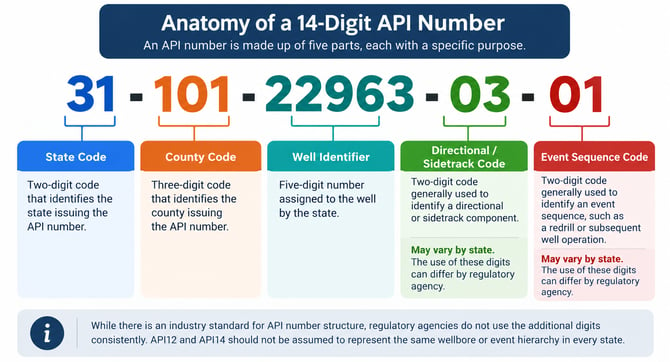
The example below shows the five components of an API14:
Why Can API Numbers Differ by State?
While there is an industry standard for API number structure, regulatory agencies have implemented the standard differently over time.
The additional digits in API12 and API14 may be used differently depending on the state or regulatory agency. This is especially relevant for wells with sidetracks, redrills, laterals, or subsequent operations.
Because of these differences, API12 and API14 should not be assumed to represent the same wellbore or event hierarchy in every state.
Learn More About API Numbers
Our API Number blog series provides additional background on the API number standard and examples of how numbering practices vary by state:
-
History of the API Number — Learn about the history of the API number standard and what each portion of the identifier represents.
-
Oklahoma's API Issue — Learn how Oklahoma's historical numbering practices differ from the standard and how those differences affect API numbers.
-
APIs in Alaska — See how Alaska handles API numbers for redrills, laterals, spokes, and other complex wellbore configurations.
-
APIs in Kentucky — Learn how Kentucky's permitting practices can result in different API numbers for subsequent well operations.
Frequently Asked Questions
Q: Do the last four digits of an API14 mean the same thing in every state?
A: No. Regulatory agencies have implemented API numbering differently, so the additional digits should not be assumed to represent the same wellbore or event hierarchy in every state.
Q: If a state only provides a 10-digit API number, how does WellDatabase handle API12 and API14?
A: When the state does not provide the additional digits, WellDatabase defaults those digits to zeros. For API12, the last two digits default to 00. For API14, the last four digits default to 0000.
Q: Why is the UWI field blank for my well?
A: WellDatabase uses API numbers for U.S. wells and UWI numbers for Canadian wells. If you are viewing a U.S. well, the UWI field is expected to be blank. Refer to the well's API fields for its well identifier.
Q: Why can API numbers for related wells look different from state to state?
A: State and regulatory agency practices vary, particularly for sidetracks, redrills, laterals, and subsequent well operations. See the API Number blog series above for examples of how individual states handle these situations.
Q: Where can I learn more about how API numbers are assigned?
A: Start with History of the API Number for an overview of the standard. The Oklahoma, Alaska, and Kentucky articles provide examples of how state-specific practices can differ.
Explore additional articles by searching the topics on the left. If you have any questions, feel free to email support@welldatabase.com